
Choosing a tool brand is not about catalogs or promises. I often see distributors struggle because the real decision is deeper than price or product range. It is about risk, trust, and long-term stability.
Distributors care most about product reliability, battery platform consistency, supply chain stability, and long-term profit security. They avoid unstable brands even if the price is lower.
In my daily work at YOUWE, I talk with importers from Italy, Germany, and Brazil. I notice one pattern. They do not start with product features. They start with fear. Fear of returns. Fear of slow delivery. Fear of unstable quality. This article is based on those real conversations.
What Do Distributors Look for When Choosing a Tool Brand?
Distributors always start from risk control. They do not start from excitement. I see this every week when I talk with buyers from Europe and South America.
Distributors mainly look for stable quality, predictable supply, and a brand that will not create hidden costs or customer complaints after shipment.
When I work with new partners, I always notice the same mindset. They already have sales channels. They already have customers. Their biggest problem is not selling. Their biggest problem is returns and instability.
Quality Expectation in Real Market
Distributors do not trust samples alone. They want batch stability. One good sample is not enough. They want 1000 units to behave like 10 units.
They check:
- Torque consistency in drills
- Battery discharge stability
- Motor heat control
- Assembly tolerance
| Key Area | Distributor Focus | Risk if Failed |
|---|---|---|
| Motor | Stability | Returns increase |
| Battery | Cycle life | Reputation damage |
| Housing | Durability | Warranty cost |
My Experience from YOUWE Projects
I remember a client from Spain. He tested three suppliers. One sample looked perfect. But after 200 units, problems started. That supplier lost the order.
I learned one thing from this case. Distributors care more about batch risk than unit cost.
How Important Is Product Reliability and Consistent Quality?
Reliability is the first filter. If a brand fails here, nothing else matters.
Product reliability decides if a distributor continues cooperation or switches supplier after the first shipment.
I often explain to clients that reliability is not only about failure rate. It is about expectation consistency. If customers expect 2 hours runtime, and they get 1.5 hours sometimes, trust drops.
What “Consistency” Means in Real Orders
Consistency includes:
- Same battery performance across batches
- Same torque output across production cycles
- Same packaging quality
- Same accessory fitment
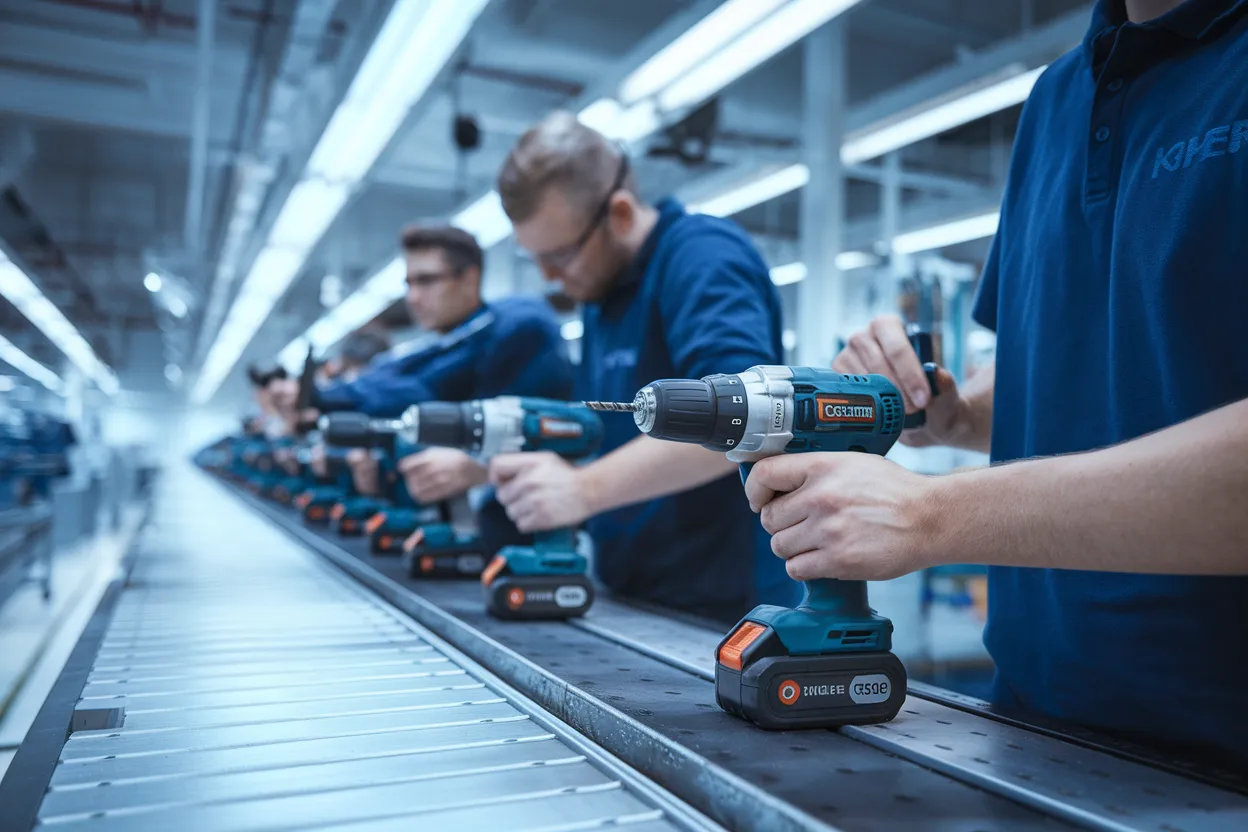
This is why many European importers ask me about IQC and OQC processes first.
YOUWE Manufacturing Control System
At YOUWE, we control quality in three steps:
- Incoming inspection (IQC)
- In-process control (IPQC)
- Final inspection (OQC)
This is not marketing. This is survival for distributors.
Why Does a Unified Battery Platform Matter to Distributors?
Battery system is not a technical detail for distributors. It is a sales strategy tool.
A unified battery platform helps distributors reduce SKU complexity and increase cross-selling between tools.

When I visit importers in Germany or Italy, I see one problem again and again. Too many incompatible batteries. This creates warehouse pressure and slow inventory turnover.
Battery System and Inventory Pressure
If a distributor sells 10 tools with 10 batteries, inventory becomes heavy. If they use one system, everything becomes easier.
Benefits:
- Lower stock risk
- Easier bundle selling
- Faster warehouse rotation
| System Type | SKU Complexity | Sales Efficiency |
|---|---|---|
| Mixed batteries | High | Low |
| Unified 21V system | Low | High |
My Field Observation
One Polish distributor told me clearly. “I do not want more products. I want smarter combinations.” This sentence changed how I design product lines.
How Do Pricing and Profit Margins Influence Brand Selection?
Price is not the first factor, but it is always a control factor.
Distributors choose brands that protect their margin while staying competitive in local retail markets.
In my experience, distributors do not ask “cheap or expensive”. They ask “can I still sell after adding logistics, tax, and warranty cost”.
Real Margin Structure Thinking
Distributors calculate:
- Import cost
- Local VAT or duty
- Warehouse cost
- Warranty reserve
- Retail competition price
If one part fails, margin disappears.
Simple Margin Table Example
| Cost Item | Impact |
|---|---|
| Factory price | Base |
| Logistics | Medium |
| Warranty | High risk |
| Market price pressure | Critical |
My Experience with EU Buyers
Many buyers from Spain told me they prefer stable mid-price products instead of low-price unstable products. Because returns destroy profit faster than high cost.
What Supply Chain Capabilities Do Distributors Expect?
Supply chain is the hidden decision factor.
Distributors expect stable lead time, predictable production schedules, and flexible shipping solutions.
When I talk with importers, they always ask the same question after product selection. “Can you ship on time every time?”
Key Supply Chain Expectations
They care about:
- Lead time stability (30–45 days)
- Sample speed (7–15 days)
- Bulk flexibility
- Customs support
YOUWE Supply Model
We support:
- OEM fast sample system
- ODM development cycle
- Truck freight to Europe (20–25 days)
- Full export documentation
This reduces uncertainty for distributors entering new markets.
How Does Brand Positioning Affect Sell-Through Rate?
Brand positioning decides how fast products move in the market.
Clear positioning helps distributors sell faster and avoid stock stagnation.
I often see brands fail not because of product, but because of unclear positioning. Customers do not understand why they should buy.
Clear vs Confused Positioning
Clear brands:
- Focus on one battery system
- Focus on one market level
- Focus on clear use case
Confused brands:
- Too many models
- No clear target user
- Mixed quality levels
| Positioning Type | Sell-through |
|---|---|
| Clear | Fast |
| Confused | Slow |
My Observation in Italy Market
Italian distributors told me they prefer fewer but stronger product lines. They do not want confusion in catalog.
What Marketing and Sales Support Do Distributors Need?
Distributors do not only buy products. They also need support to sell.
Marketing support increases sell-through speed and reduces distributor sales cost.
In my work, I see many factories stop at production. But distributors need more.
Core Support Needs
They need:
- Product photos
- Video content
- Technical sheets
- Packaging design files
YOUWE Support System
We provide:
- Branding design
- CE/GS documentation
- Amazon-ready images
- Multi-language manuals
This helps distributors enter market faster.
How Do Distributors Evaluate a New Tool Brand Before Partnership?
Evaluation is not emotional. It is structured.
Distributors test brand stability, communication speed, and technical transparency before long-term cooperation.
I join many first meetings with new partners. I see the same checklist every time.
Evaluation Checklist
They check:
- Response speed
- Sample quality
- Factory transparency
- Certification availability
| Factor | Importance |
|---|---|
| Communication | High |
| Sample test | High |
| Certification | Critical |
My Real Case Experience
A German importer once rejected a supplier only because documents were incomplete. Product was good. But trust was missing.
What Makes Distributors Stay with a Tool Brand Long-Term?
Long-term cooperation is built on stability, not excitement.
Distributors stay when supply is stable, quality is predictable, and communication is transparent.

In my experience, long-term partners reduce questions over time. Trust replaces negotiation.
Key Retention Factors
- Stable quality over years
- Predictable pricing logic
- Fast problem solving
- Continuous product updates
YOUWE Long-Term Approach
We do not only ship products. We build systems:
- Battery platform continuity
- ODM development roadmap
- Spare parts support
This is what keeps distributors active.
Conclusion
Distributors do not choose brands based on one factor. They balance risk, stability, and long-term profit. I see this every day in my work with global partners. The strongest brands are not the cheapest. They are the most predictable. I always suggest buyers start with system thinking, not product chasing. If someone is planning to enter this market, I believe early conversations with a real manufacturer can reduce many hidden risks.